Letter of Pierre d'Arcis, Bishop of Troyes, to Pope Clement VII on the Cloth of Lirey (c. 1389)
 Click to enlarge
Memorandum of Pierre d’Arcis, Bishop of Troyes
To The Avignon Pope Clement VII
Written circa 1389
Translated from Latin by H. B. Mackey, “The Holy Shroud of Turin,” The Dublin Review, January 1903
Bibliothèque Nationale de Paris, Collection de Champagne, v. 154. folio 137.
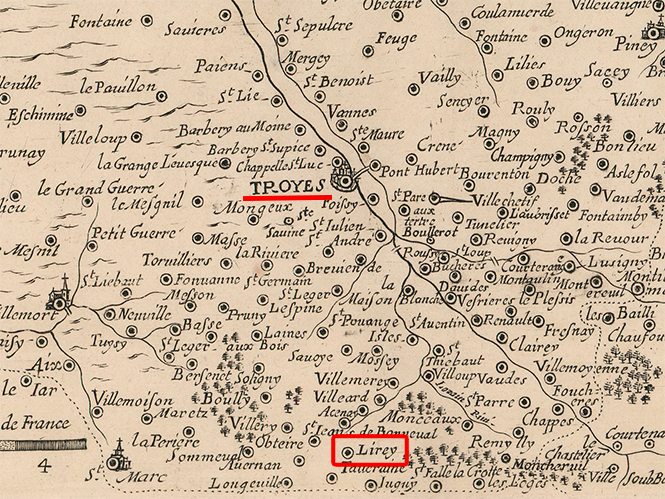
Since it has come to our notice that in the collegiate church of Lirey, in our diocese, there has been displayed for some time a certain cloth cunningly painted, upon which is represented the twofold image of one man, that is, the front and the back, and which is falsely asserted and proclaimed to be the true burial shroud in which our Lord Jesus Christ was wrapped in the tomb, and on which the entire likeness of the Savior has remained impressed.
The Dean of Lirey, deceitfully and wickedly, inflamed with avarice and cupidity, not from devotion but for gain, had the cleverness to obtain for his church a certain painted cloth on which was painted with subtle method the double image of a man, front and back; falsely asserting and making out that this was the very shroud which enveloped Christ in the sepulchre, and in which had remained thus impressed the whole image of the Saviour, with the wounds which He suffered. This was so spread abroad not only in France, but throughout the whole world, so to speak, that the people flocked from every side. Moreover, to draw the said people and artfully to get money out of them, miracles were lyingly invented, certain men being suborned to pretend that they had been healed on occasion of the exposition of the said shroud, which was believed by all to be that of the Saviour. Seeing all this, Henry of Poitiers, then Bishop of Troyes, at the persuasion of many prudent men, and, indeed, as a duty of his ordinary charge, made an investigation. Theologians and other learned men declared that this could not be the Lord’s shroud since it was marked with the Saviour’s image, and the Gospel makes no mention of such a marking. Were it true, it is not likely that the Gospels would have omitted to mention it, nor that it would have remained secret and unknown till now.
At length, after diligent efforts and from information taken, he at last detected the fraud, and found that the said cloth had been painted by the hand of an artist. It was even proved by the artist who had painted it that it was made by human skill, and was not made or given miraculously. He thereupon, after counsel, proceeded against the said dean and his accomplices, who hid the said cloth so that he could not find it, and kept it concealed during about thirty-four years, until this present year. And now the present dean, with fraud prepense, and for the sake of lucre, has suggested to Geoffrey (II.) de Charny, the temporal lord of the place, to get the aforesaid relic put back in his church in order to renew the pilgrimage and increase the revenues. The said knight, at the suggestion of the dean, who followed the example of his predecessor, has been to the Cardinal de Thoire, legate of your Holiness in France, and, suppressing the fact that this cloth had been asserted to be the shroud of the Saviour, and that it had the image of the Saviour on it, and that the Ordinary had treated the matter and that the cloth had thereupon been suppressed, he stated to the Cardinal that it was a representation or figure of the shroud, begging that he might be allowed to replace it in the church in order to be venerated by the faithful. Cardinal, without granting the petition entirely, permitted that it should be placed in the said church, or in any other becoming place, without the permission of the Ordinary or of anyone else.
Under pretence of these letters, the said cloth was openly exhibited to the people in the said church on feast days and other occasions, with the greatest solemnity, even greater than is shown there to the Lord’s body. And although, in public, it is not asserted to be the true shroud of Christ, yet this is said and proclaimed secretly, and is believed by many, especially as it was formerly called the true shroud of Christ. Moreover, it is now called not Sudarium but Sanctuarium, which gives the same idea to the common people. . . . For my part, seeing this scandal, after taking the counsel of many prudent men, I forbade the dean to expose the said cloth to the people; but he has appealed, and meantime continues the said ostension, while the knight has procured a royal warrant to the same effect. Meanwhile, also, they have spread the report that I am proceeding in this from envy, from cupidity and avarice, from the desire of getting hold of this cloth myself, as my predecessor also was accused of doing. Wherefore, I procured that the said cloth should be placed under the king’s authority, which I did without any difficulty, as the whole court of parliament is fully informed as to the superstitious finding and abuse of this shroud. Finally, the said knight has brought back letters from your Holiness confirming those of the above Cardinal, ex certa scientia, by which it is conceded to him to exhibit the said cloth to the veneration of the faithful, and by which perpetual silence is imposed on me at least, so it is reported, for I have not seen the letters. Deign, then, to provide in such sort that the above scandal and superstition may be extirpated from the root, and that this cloth be not offered for veneration either as a Sudarium, or a Sanctuarium, or a representation or figure of the Lord’s Shroud (since that shroud was not such as this), or in any other way or name. For I hereby offer to inform myself sufficiently and unquestionably, for the discharge of my conscience, on all the points above put forward about this fact.
Sources & References
- H. B. Mackey, 'The Holy Shroud of Turin,' The Dublin Review, January 1903 View source →
- Bibliothèque Nationale de Paris, Collection de Champagne, v. 154. folio 137. View source →
- Full Diocese of Troyes map (Bibliothèque nationale de France, Gallica) View source →