Bull of Pope Clement VII Regulating the Lirey Shroud Exhibitions and Imposing Penalties for Noncompliance
Bull of Pope Clement VII Regulating the Lirey Shroud Exhibitions and Imposing Penalties for Noncompliance
Issued January 6, 1390
Given at Avignon, in the twelfth year.
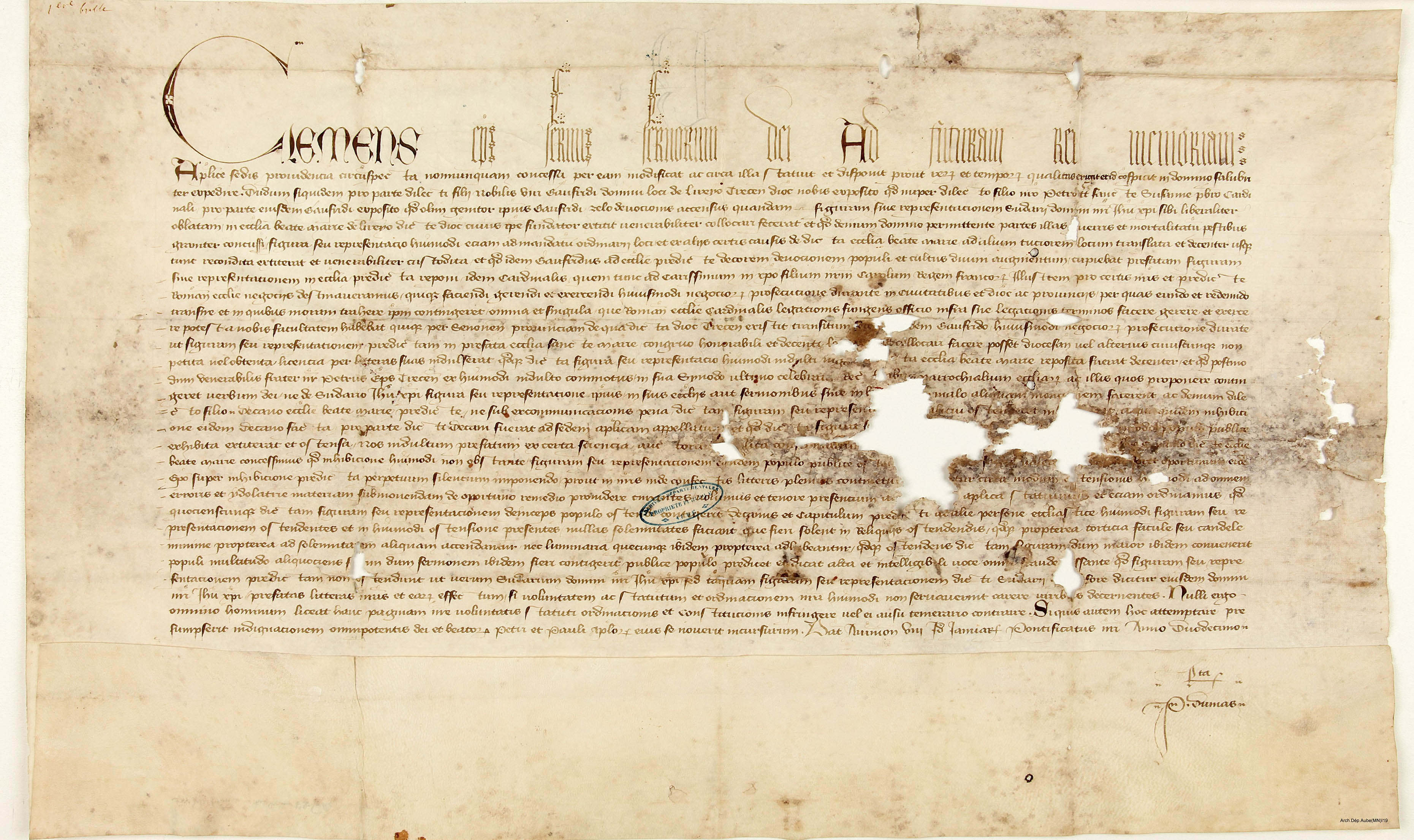 Click to enlarge
Clement VII, bishop, servant of the servants of God, for a perpetual memorial of the matter.
The prudent foresight of the Apostolic See sometimes alters grants previously made by it, and ordains and directs concerning them whatever, after weighing persons, circumstances, and times, seems in the Lord more beneficial.
Recently, at the petition of our beloved son, the nobleman Geoffroy, lord of Lirey in the diocese of Troyes, it was set before us that our beloved son Peter, then cardinal priest of [title uncertain], acting at the request of the petitioner and of the then bishop of Troyes, had granted to the said Geoffroy that a certain figure or representation of the shroud of our Lord Jesus Christ, formerly offered to the church of Blessed Mary at Lirey in the same diocese, and devoutly and reverently placed there by the founder of that church, might, with God’s favor, be kept there with due honor.
He had also granted that, for the increase of the devotion of the faithful and of divine worship, this figure or representation, which by order of the diocesan and for certain reasons had been removed from that church of Blessed Mary to another suitable and decent place, might there be reverently kept and guarded.
And since the same Geoffroy, desiring the increase of devotion in the said church and the growth of divine worship, wished that the aforesaid figure or representation be shown in that church, he approached our beloved son, then cardinal legate. Because the church was then vacant, that cardinal, exercising the office of legate of the Apostolic See in those regions, provided in the matter and issued his decision in such a way that, among other things, he granted full power to the said Geoffroy to have the figure or representation honorably and suitably placed in the aforesaid church of Blessed Mary, so that it might be shown there to the faithful and to others, as is said to be more fully contained in his letters.
Afterward, however, our venerable brother Peter, bishop of Troyes, having learned of the matter, at his recent synod, through the rectors of parish churches and through others, caused it to be publicly proclaimed that the said figure or representation in that church was not, under any circumstances, to be shown or exhibited to the people, in any place or under any pretext.
He also declared that if the dean of the aforesaid church of Blessed Mary should presume to show or exhibit such a figure or representation, he would incur the sentence of excommunication. Because of this, the said dean, on behalf of himself and of the said church, appealed to the Apostolic See and to us.
Therefore, wishing to provide a sound remedy in this matter, we grant that, notwithstanding the aforesaid prohibition, the same figure or representation may be publicly shown to the people, provided that no perpetual silence be imposed concerning the warning contained in our other letters, but rather that error and idolatry be prevented by an appropriate remedy.
Accordingly, whenever the dean and chapter of the said church, and the other ecclesiastical persons who take part in the showing of the said figure or representation to the people, are engaged in that showing, they shall perform none of the solemn ceremonies customarily used in exhibiting relics.
For that reason, no candles at all are to be lit there as for some solemnity, and no lamps or other lights are to be carried there for that purpose, lest the people, seeing such things, imagine that the cloth itself is the true shroud, and lest some false belief be conceived by the crowd.
Instead, the dean himself, or another suitable person, shall publicly say and declare to the people in a loud and intelligible voice that this is not the true shroud of our Lord Jesus Christ, but a figure or representation of the shroud said to have been that of our Lord Jesus Christ.
And if the aforesaid dean, chapter, or others should dare to act otherwise, they shall not be able to escape the penalties and ordinances contained in our letters on this matter.
Therefore let no one whatsoever infringe this page of our will, statute, ordinance, and grant, or rashly oppose it. If anyone should presume to attempt this, let him know that he will incur the indignation of almighty God and of the blessed apostles Peter and Paul.
Given at Avignon, on the eighth day before the Ides of January, in the twelfth year of our pontificate.
Why it matters
This bull matters because it does more than repeat a permission already granted. It turns the Lirey dispute into a controlled legal settlement: the exhibitions may continue, but only under conditions designed to prevent the crowd from treating the cloth as an authenticated relic of Christ’s burial.
Act Clement VII allows the figure or representation at Lirey to be shown publicly despite the prohibition issued by Bishop Pierre d'Arcis of Troyes.
Consequence The local episcopal ban is overridden by papal authority, and the dean and chapter regain the right to exhibit the object.
Act He forbids the clergy to stage the exhibition with the solemn ceremonies used for relic ostensions.
Consequence The display is stripped of the visual signals that would make pilgrims think they are seeing a recognized major relic.
Act He specifically bans candles, lamps, and other lights carried for the ceremony.
Consequence The exhibition is not to look like a liturgical or relic cult, which reduces the risk of what the bull calls error and idolatry.
Act He requires the dean or another suitable cleric to announce publicly, in a loud and intelligible voice, that the object is not the true Shroud of Christ but only a figure or representation.
Consequence The clergy are legally required to tell the crowd that the cloth is not the authentic burial shroud.
Act He states that anyone who acts otherwise remains subject to the penalties and ordinances already laid down in his letters on the matter.
Consequence The dean, chapter, and other participants cannot ignore the disclaimer or the ceremonial restrictions without exposing themselves to ecclesiastical punishment.
Taken together, the bull sets out a compromise that would shape the Lirey exhibitions for the rest of the controversy. The object could still attract pilgrims and public devotion, but only as a representation shown under papally imposed controls, not as a relic to be honored with the normal rites of an authenticated holy object.
Sources & References
- Archives departementales de l'Aube, Lirey dossier viewer, image 106142 (bull of Pope Clement VII regulating the Lirey Shroud exhibitions and imposing penalties for noncompliance). View source →