The 1901 Vatican Proceedings on the Shroud of Turin
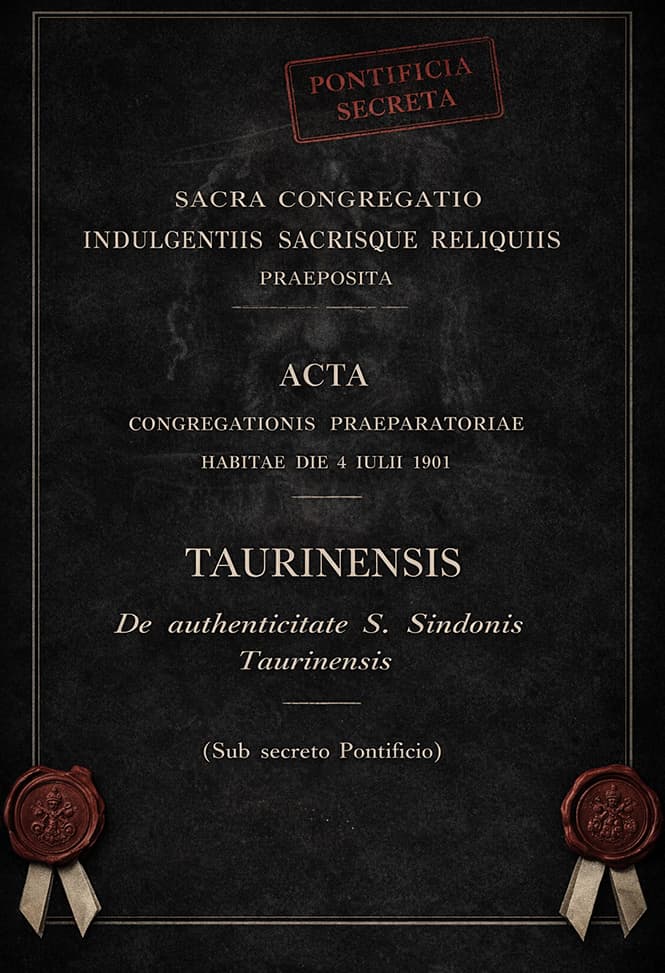
Sacred Congregation
for Indulgences and Sacred Relics
in charge of
Proceedings
of the Preparatory Congregation
held on 4 July 1901
Turin
On the authenticity of the Holy Shroud
of Turin
(Under Pontifical secrecy)
The congregation was held in the Palace of the Apostolic Chancery in the presence of the undersigned Secretary of the Sacred Congregation in charge of Indulgences and Sacred Relics. Present were the Most Reverend Consultors: Joseph Ceppetelli, Archbishop of Myra; Fr. Master Albert Lepidi, of the Order of Preachers, Master of the Apostolic Sacred Palace; Fr. Master Thomas Esser, of the Order of Preachers, and Secretary of the Sacred Congregation of the Index; Fr. Francis M. Pisi, of the Order of St. John of God; Fr. Francis Beringer, S.J.; Fr. Roderic of St. Francis of Paula, of the Discalced Carmelite Order; the Most Reverend Don Hermes Binzecher; the Most Reverend Don Benedict Melata; the Most Reverend Don Nicholas Mattioli, of the Order of Hermits of St. Augustine.
After invoking divine light, the question is presented by the Most Reverend Fr. Secretary:
ON THE AUTHENTICITY OF THE HOLY SHROUD OF TURIN.
Question I. Whether the authenticity of the Holy Shroud of Turin is established?
and to what extent in the negative
Question II. What is to be done in this case?
The Most Reverend Fr. Beringer further observes the following on this matter:
To the principal question, namely, concerning the authenticity of the Shroud, it does not seem to him that any answer can be given from the documents other than a negative one, and this he proved at length in his opinion, both from authority and from the very origin and history of the Shroud. He also shows that the reasons proposed by the Most Reverend Colomiatti in defense of the authenticity lack solid foundation.
More difficult will be the solution of the other question, namely, what is to be done in this case. To this also, in his opinion, he responded as best he could, indicating the prescriptions of the general councils and certain examples from other ages. He adds also another point: a few years ago, concerning the non-propagation of apocryphal indulgences, in the Constitution “On the prohibition and censorship of books,” our Most Holy Lord Pope Leo XIII most wisely decreed as follows (General Decree, chap. 6, no. 16): “It is forbidden to all to publish in any way apocryphal indulgences and those proscribed or revoked by the Holy Apostolic See. Those which have already been published are to be taken out of the hands of the faithful.” Why could not the Holy See proceed in a similar way against relics which are openly shown to be false? Certainly infallibility, and that saying of the Apostle that the Church is “the pillar and ground of the truth” (1 Tim. 3:15), ought not to be applied to the matter of indulgences and of individual relics, as he showed in his opinion; every caution also and prudent discretion must be used, lest the body of the faithful be scandalized in any way, but on the other hand, could not the authority and honor of the Church and of the Apostolic See also suffer great harm if it should seem to tolerate further the veneration of a relic whose falsity has now been proved so openly? Do not even simple believers have the right to demand that they not be deceived by relics that are manifestly false?
With regard to this second practical question itself, namely, what should now be done, two notices are reported concerning the oft-mentioned work of Canon Chevalier, which have been published in recent months in public papers; he could no longer insert these into his opinion, because it had to be printed with great haste. Therefore these now, as let him be permitted to add a certain supplement, for it usefully confirms the things that he showed and proposed in his opinion.
The first judgment is that of the Reverend Doctor Funk, priest of the Diocese of Rottenburg and celebrated professor of Catholic theology at the University of Tübingen. In the theological journal published every third month by the Catholic professors of that university, he first briefly reports, in issue 2 of the year 1901, page 287, what has been published in recent years on both sides concerning the Turin Shroud. Then, speaking of Canon Chevalier’s book, whom he repeatedly calls learned and well deserving in liturgical scholarship, he continues as follows: “The history of this Turin relic, from the documents presented, is so clearly evident that judgment concerning it can hardly be doubtful…. But that compromise by which the judicial action was concluded, by Clement VII, namely that the exposition of the Shroud was also to be permitted in the future, though with certain prescribed precautions, see Opinion p. 17, could by its very nature not last long. For if that image was allowed to be shown to the people, they were very easily led to believe in the Shroud’s supernatural origin, and this could not be prevented even by the aforesaid precautions, which, if they were really observed, certainly did not last long. And so in fact it happened.”
After a few intervening remarks, the same author continues: “I must state openly that Canon Chevalier’s book affords great satisfaction and has much value. For this work, as the canon himself observes on page 58, shows by a perfect example and almost before the eyes how a fable of this kind can arise and endure. In this matter the truth is not gladly heard, today even less than before, for the desire for marvelous things has spread much more widely than the love of truth. Therefore we easily understand that Canon Chevalier, not without long hesitation, as he himself admits, resolved himself to undertake this, so to speak, campaign, which may provoke other similar ones, against that error. And in truth there have not been lacking those who attacked him, nor will his opponents easily fall silent in the future, although concerning the matter is shown to be so manifest.” “Learned men, however,” thus Professor Funk concludes, “ought not to be overly troubled by these attacks, and credit must be given to our author for having despised them.”
The second judgment comes from North America, whose citizens, as is well known, willingly boast of the highest and fullest freedom, and therefore this freer manner of speaking will perhaps more easily be pardoned in this priest. In the ecclesiastical periodical which, with the approval of several bishops, is published every month in the city of St. Louis in the German language, the “Pastoral Journal” (Pastoral-Blatt), in its third issue for the month of March of the present year, page 42, speaking first of false relics in general, it has the following to say: “Many priests would gladly wish to remove relics of that kind whose falsity is manifest, for they know that to err is human, but to persist in error is shameful…. The difficulty, however, for us priests, to whom the full truth ought to be of great interest, often lies in this, that the truth cannot be heard safely. Therefore, when the matter concerns the removal of false relics, ecclesiastical authority ought to decide the matter and proceed seriously against them. A very suitable means, for example, is the pastoral visitation of bishops. Chairs, for instance, of the Three Holy Kings and similar things would quickly be removed from church inventories, if ecclesiastical authority pressed the matter seriously; otherwise those very frauds are attributed to it as having been continued too long.”
And then, speaking of the Turin Shroud and of Canon Chevalier’s book, the author continues as follows: “If the things which Chevalier has discovered and published by his learned studies are to be recognized as true and unquestionable, can we not rightly hope that at last the public exhibition of this Shroud will either be entirely abolished or at least altered? But if worship of this kind should still be permitted in the future in the same way, we shall have that hyper-conservatism, as they call it, so harmful, almost fortified and entrenched by the silence of ecclesiastical authority itself, against which not even the soundest critical method can accomplish anything.”
These are the things that he wished now to state beforehand, or rather to add to his opinion.
The Most Reverend Fr. Ceppetelli, although from the historical documents brought forward by the Most Reverend Consultor Beringer it ought clearly to be concluded, with regard to Question I, that the authenticity of the Holy Shroud of Turin is not established, nevertheless admits that it is certainly arduous and difficult to answer Question II, since the matter concerns most celebrated relics, which have always been held in the greatest honor and veneration for almost five centuries, not only among the people of Turin but also among all the faithful, indeed even honored with special reverence by bishops themselves and by the Roman pontiffs, who believed it to be the very cloth in which the body of Christ was wrapped after death. Therefore, if at present its cult were to be proscribed and its veneration condemned, there is no doubt that excessive astonishment, indeed scandal, would be aroused among the faithful, and an occasion would be given to the enemies of the Church to slander and mock it, since for so many centuries it permitted the cult of these relics without any investigation into the truth of the matter. Therefore he judges that the Archbishop of Turin and the other bishops of the subalpine region should be written to, so that in the future they may take care that the question of the genuineness of the Holy Shroud of Turin is no longer raised, indeed that complete silence be kept on this question, and moreover that they gradually withdraw the faithful from so solemn a cult as has hitherto been shown to it, and especially refrain from special signs of veneration, which certainly ought to be rendered if the Shroud were truly authentic.
The Most Reverend Fr. Lepidi agrees with the opinion of the Most Reverend Fr. Ceppetelli. Yet he does not exclude that a response should be given to the doubts proposed. Therefore to Question I he would reply: no pronouncement is to be made. To Question II: that the image of the Turin Shroud may be venerated, whether it is the original Shroud, or whether it is an original image of the Shroud.
But the response to Question I is not pleasing to everyone, since matters have now reached the point that the question of the authenticity of the Shroud has already become public, and documents have been brought forward here and there, and lines of reasoning set out, from which that same authenticity is excluded, rather than strengthened, and therefore silence in such a case could be taken as an argument from which it would be inferred that the Holy See itself is made an accomplice of fraud and error in the cult of the Holy Shroud.
The Most Reverend Fr. Esser likewise thought that one should not remain silent, but rather set forth the questions as follows:
I. Whether the authenticity is established of the so-called Shroud that is kept at Turin?
and to what extent in the negative,
II. Whether in the future it may be publicly exposed for the veneration of the faithful?
To these he replies. To I: provision is made in II. To II: it can be permitted, and the meaning can be explained by indicating that the cult is referred to the image or representation of the Instrument or Monument of the Lord’s Passion. In this way he thinks that the question of authenticity is not decided by the Holy See, which leaves scholars entirely free to dispute about the authenticity of the Turin Shroud, while at the same time teaching that even if the Turin Shroud were not original, it could nevertheless be venerated as an image representing the signs of the Passion, indeed of the Redeemer himself, and with latreutic worship, as images of Christ crucified are venerated, to this pious end, namely that the devotion of the faithful may be fostered toward Christ Jesus who suffered for us, and who after death, wrapped in the shroud, was laid in the tomb.
And almost all agreed with this opinion, we say almost all, because the Most Reverend Binzecher, regarding the first doubt, first notes that the cult of holy relics is, as all know, relative, and therefore the devotion of the faithful suffers no harm if perhaps it should be discovered that the relics to which cult is rendered are false. But more correctly, he notes, the first doubt can least of all be resolved in this case, since unless the matter concerns relics of saints who passed from this life in more recent times, the authenticity of others can scarcely be positively proved, so that for the most part their authenticity is upheld only negatively, so that if in this case it were determined that the authenticity of the Holy Shroud, a very broad way would be opened for casting doubt on many other notable relics, as indeed some already do. Now anyone can easily see what very serious scandals and doubts might arise from this, not only concerning relics, but also concerning matters pertaining to the faith, since believers of the common crowd, through ignorance, easily confuse what is purely historical with what is dogmatic, and may judge the one false just as much as the other, so that faith itself could be shaken.
In the present case, even if there are documents directly proving the falsity of the Holy Shroud, as the Most Reverend Consultor demonstrates, can it be concluded with certainty that these documents are beyond every exception? Or can it be excluded that in the future some document may be discovered proving the contrary?
Therefore he concludes that in this case one must refrain from any decision, and that matters should be left in the state in which they are found, especially since reasons are not lacking by which some cult may be rendered to the Turin Shroud, even if it is not authentic.
The other consultors do not at all agree with this opinion, for they think that the question must be resolved in some way, because if this is not done the Holy See would in a certain way show its weakness, while on the contrary it has nothing to fear from the truth once discovered.
The Most Reverend Fr. Risi submits his opinion in writing in the following terms:
I shall state my opinion, setting aside every human consideration, and having in view only the truth, the interests of God, and of the Catholic Church.
The documents produced by Professor Chevalier, reported in the opinion of the Most Reverend Consultor, clearly prove that the Turin Shroud is not the true one.
The decision of Clement VII cannot be said to be that of an antipope. All historians admit this, along with St. Antoninus, who in Chron. 3, p. tit. 22, c. 2, says that it was still undecided whether the true pope was Urban VI or Clement VII.
But in any case, those concerned with the Turin Shroud should prove that the above-mentioned documents are spurious, since their probative force consists in their being contemporary historical documents. A term could be assigned to the interested party to produce proofs, if they have any, against the genuineness of the aforesaid documents. Once that term has passed, and no proofs have been produced, every kind of cult toward the Turin Shroud should not be destroyed, but that relative worship of latria should be forbidden which would be due to the true Shroud. The Turin Shroud is like any cross made in the image and imitation of the true Cross of Our Lord. Any blessed cross may be exposed to public veneration, but those acts of special worship that are rendered to the true Cross are not rendered to it. The same must be said of the Shroud of Turin. To avoid scandal, and not disturb the conscience of the people, one may continue to render it worship, while excluding those acts, rites, and special ceremonies that belong uniquely to the true Shroud, in which the Sacred Body of the Redeemer was wrapped.
Since ecclesiastical authority cannot permit falsehood and imposture to spread, gain credit, and be strengthened in the Church, I am of the opinion that a precise order should be given to those whose duty it is to watch over and forbid such things, that it not be preached or printed that the Turin Shroud is the true Shroud in which the adorable Body of Our Lord was wrapped, and that especially the panegyrists of the Turin Shroud should be forbidden to rail against those who challenge its authenticity.
The silence of the Holy See, and the toleration of the status quo, in the present circumstances, while the controversy is raging and an appeal has been made to this Sacred Tribunal, would be interpreted by the fanatical supporters of the Turin Shroud as a victory on their part, which would imply a certain cooperation in the maintenance and reinforcement of the lie and the imposture.
The Most Reverend Fr. Rodericus would propose the doubts in the same way as the Most Reverend Fr. Esser proposed them. The Most Reverend Melata is of the same opinion, who moreover adds in response to the second doubt in which it is said that veneration of the Holy Shroud may be permitted, and as to the meaning, he says that the meaning is to be taken from those things which the same Fr. Risi noted in the last place, namely that those to whom it pertains should be vigilant and prevent the Turin Shroud in the future from being extolled with praises, or some figure being given to it by which it is more strongly affirmed that the aforesaid Shroud is the very same one in which the Body of Jesus Christ was wrapped, and that other things be done which imply special veneration for it, which would without doubt have to be rendered if it were the true and original Shroud.
The proceedings having been concluded in the customary way, thanks be to God, the session came to an end.
† Franciscus Sogaro, Archbishop of Side Secretary.
Why it matters
These proceedings matter first because this was not a minor or local discussion. The consultors present were senior Vatican insiders and specialist advisers to the Roman Curia:
- Fr. Albert Lepidi, O.P.: Master of the Sacred Apostolic Palace, effectively the pope’s theologian.
- Archbishop Joseph Ceppetelli: major Roman prelate and consultor of the Holy Office.
- Fr. Thomas Esser, O.P.: Secretary of the Sacred Congregation of the Index.
- Fr. Francis Beringer, S.J.: leading Catholic authority on indulgences.
- Archbishop Francesco Sogaro: Secretary of the Sacred Congregation for Indulgences and Sacred Relics, who signed the proceedings.
Their presence shows that the question of the Shroud’s authenticity was being handled at a serious institutional level by the Vatican’s own designated experts on relics, indulgences, doctrine, and public devotional practice.
The document is also important because its central historical conclusion is strikingly clear. Long before the 1988 radiocarbon dating, the consultors were already weighing whether the Shroud’s authenticity could be sustained from the documentary record alone. Fr. Beringer argued directly that the evidence led to a negative conclusion, and most of the discussion proceeds from that premise. The real dispute in the room was not mainly over the strength of the historical case, but over what the Church should do if the evidence against authenticity was judged strong.
That is where the proceedings become especially revealing. Archbishop Ceppetelli feared scandal and favored a gradual quieting of the cult. Fr. Lepidi preferred no formal pronouncement. Others objected that silence would make the Holy See appear complicit in error. Fr. Esser proposed the solution that drew the broadest support: do not settle authenticity definitively, but allow continued veneration by treating the Turin Shroud as an image or representation of Christ’s Passion rather than as an authenticated relic. Fr. Risi took the hardest line, insisting that the Church could not allow falsehood to spread and calling for explicit restraint on preaching or printing that the Shroud was genuine. Binzecher stood out as the main dissenter, warning that a formal judgment here could unsettle confidence in other relics as well.
Taken together, the proceedings offer a rare window into how the Vatican handled inconvenient historical evidence behind closed doors. They show a Church institution trying to balance truth, public order, devotion, and the risk of scandal. They also help explain a longer-term pattern: the distinction between authenticated relic and devotional image, argued here in 1901, closely resembles the cautious posture the Church would continue to maintain in later decades.
Finally, the document shows that pressure was not only internal. The discussion explicitly cites outside voices such as Professor Funk of Tübingen and an American pastoral journal, both of which argued that the evidence assembled by Canon Ulysse Chevalier made continued silence difficult. For that reason, these proceedings are valuable not only as a judgment on the Shroud, but also as evidence of the broader Catholic debate over criticism, relics, and ecclesiastical credibility at the start of the twentieth century.
Sources & References
- Text provided for site entry: Proceedings of the Preparatory Congregation held on 4 July 1901. View source →