STURP Scientific Examination
From October 8 to 13, 1978, the Shroud of Turin Research Project, or STURP, carried out the first large-scale direct scientific examination of the cloth using modern instruments. The campaign was historically important, but it did not settle the Shroud’s authenticity. It produced a large body of data, raised new questions, and left major disputes unresolved.
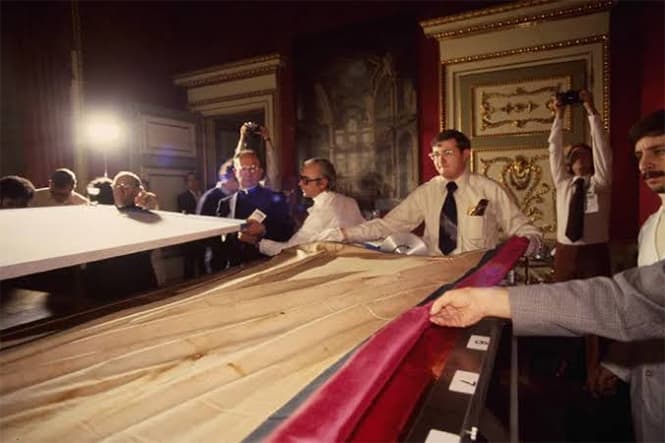
The STURP Team
The published 1978 roster lists 33 investigators and collaborators. Of those, 25 were marked as direct participants in the Turin examination itself, while 8 worked later in the United States with data or samples. Later summaries often blur that difference.
By primary role, the team included:
- 5 photography and documentation specialists
- 9 spectroscopy, X-ray, thermography, and other instrument specialists
- 6 measurement and image-analysis specialists
- 4 chemistry, biochemistry, and tape-sample specialists
- 3 medical, forensic, and conservation specialists
- 5 technical-support, logistics, and public-relations staff
- 1 biophysicist
Taken together, the roster shows a mixed technical team built around imaging, chemistry, instrumentation, logistics, and documentation.
Academic
Rudolph J. Dichtl
Technical Support for All Experiments
University of ColoradoAlan Adler
Biochemist and Tape Sample Analysis
Western Connecticut State UniversityJohn P. Jackson
STURP President and Measurements/Analysis
U.S. Air Force AcademyEric J. Jumper
STURP Vice-President and Measurements/Analysis
U.S. Air Force AcademyErnest H. Brooks II
Scientific Photography
Brooks Institute of PhotographyMark Evans
Microphotography and Photomicroscopy
Brooks Institute of PhotographyVernon D. Miller
Scientific Photography
Brooks Institute of Photography
None-Academic
Joseph S. Accetta
Infrared Spectroscopy
Lockheed CorporationSteven Baumgart
Infrared Spectral Measurements
U.S. Air Force Weapons LaboratoriesJohn D. German
Technical Support for All Experiments
U.S. Air Force Weapons LaboratoriesRobert Bucklin
Medical and Forensics
Harris County, Texas, Medical Examiner’s OfficeDonald Devan
Scientific Photography and Image Analysis
Oceanographic Services Inc.Robert Dinegar
Chemistry and Tape Sample Removal/Analysis
Los Alamos National Scientific LaboratoriesDonald Janney
Image Analysis
Los Alamos National Scientific LaboratoriesJoan Janney Rogers
Technical Support
Los Alamos National Scientific LaboratoriesJ. Ronald London
X-Ray Radiography and X-Ray Fluorescence
Los Alamos National Scientific LaboratoriesRoger A. Morris
X-Ray Fluorescence
Los Alamos National Scientific LaboratoriesRaymond N. Rogers
Chemistry and Tape Sample Removal/Analysis
Los Alamos National Scientific LaboratoriesLarry Schwalbe
Physics and X-Ray Fluorescence
Los Alamos National Scientific LaboratoriesDiane Soran
Chemistry and Archaeology
Los Alamos National Scientific LaboratoriesKenneth E. Stevenson
Public Relations
IBMThomas F. D’Muhala
Logistics
Nuclear Technology CorporationJim Drusik
Conservation
Los Angeles County MuseumJoseph Gambescia
Medical Analysis
St. Agnes Medical CenterRoger Gilbert
Visible/UV Spectroscopy
Oriel CorporationMarty Gilbert
Visible/UV Spectroscopy
Oriel CorporationThomas Haverty
Thermography
Rocky Mountain ThermographJohn Heller
Biophysics
New England InstituteJean Lorre
Image Analysis
Jet Propulsion LaboratoryDonald J. Lynn
Image Analysis
Jet Propulsion LaboratoryRobert William Mottern
Image Analysis and X-Ray Radiography
Sandia National LaboratorySamuel Pellicori
Visible/UV Spectroscopy
Santa Barbara Research CenterBarrie M. Schwortz
Documentation Photography
Barrie Schwortz Studios
Institutional Background
STURP did not arise as a detached outside authentication panel assembled by a broad neutral body. Its early development ran through the Holy Shroud Guild in America, which promoted information about the Shroud and encouraged scientific work on it in the United States. John Jackson’s early research also developed through that same network.
That background does not invalidate the work, but it is important context. STURP grew out of an already interested pro-Shroud environment rather than a neutral commission assembled from scratch. The overlap was not merely informal: the Guild helped connect researchers, served as an important liaison to the Shroud’s custodians, and at least one STURP participant, Joseph Gambescia, is documented elsewhere as having served on the Guild’s executive committee.
Equipment and Methods
The team brought over 70 pieces of scientific equipment weighing several tons to Turin. Their investigation employed:
- X-Ray Fluorescence to analyze elemental composition
- Reflectance Spectroscopy to study image formation
- Infrared Thermography to detect subsurface features
- Ultraviolet Photography to reveal fluorescent properties
- Microscopic Examination of fibers and image areas
- Chemical Tests on sticky tape samples taken from the Shroud
The work was ambitious for its time and created the foundational modern dataset for later Shroud studies. At the same time, access was brief, sampling was limited, and only a small number of researchers were allowed to work directly on the cloth. STURP could characterize many surface features, but characterization is not the same thing as proving origin or mechanism.
The team’s strengths also defined its limits. The roster was especially strong in imaging, chemistry, spectroscopy, radiography, photography, medicine, and technical support. That made STURP well suited to study the cloth’s physical and chemical properties, but less obviously equipped to answer the broader historical question of how a medieval relic image might have been made. William Meacham, who wrote sympathetically about the Shroud, treated authentication as a question that draws not only on scientific analysis but also on history, archaeology, art history, and related fields. That wider frame helps explain why STURP’s failure to explain the image should not be taken by itself as proof that the image was beyond human manufacture.
Key Findings
After three years of analysis, STURP published several significant findings.
The Image
- The image is not painted: no pigments, dyes, or stains were found that could account for the image
- The coloration resides only in the topmost fibers, with no capillary action into the weave
- The image appears to be the result of oxidation and dehydration of the Shroud’s cellulose fibers
- The image encodes three-dimensional information
The Blood
- The stains tested positive for blood using multiple independent tests
- The blood appears to be real human blood, type AB
- The blood chemistry suggests genuine wound trauma
These were the claims that made STURP famous. They were influential, but they were not the same thing as proving authenticity.
What STURP Did Not Prove
STURP’s own summary was narrower than many later retellings. It argued that no pigments, paints, dyes, or stains had been found on the fibrils in a way that explained the image, that the body image involved oxidation and dehydration of the linen’s microfibrils, and that no known physical or chemical method explained the totality of the image.
That is not the same as proving authenticity. It is a statement about the limits of the team’s explanatory success. STURP did not demonstrate that the Shroud was first-century, that the image was miraculous, or that all natural explanations had been eliminated.
This is also where STURP’s language became more confident than its evidence. The team admitted that the mechanism of image formation remained unsolved, yet elsewhere summarized the image as not being the product of an artist. That went beyond the narrower conclusion the data could really support. At most, STURP argued that the image did not match an ordinary painted image as the team understood it. It did not prove that the image could not have been produced by a medieval artist, an unconventional artistic process, or some other human method that the team had not fully tested.
The medieval documentary record also pushes in the opposite direction. Pierre d’Arcis described the cloth as something painted by human skill, Clement VII’s 1390 bull required it to be presented publicly as a painting or picture made in the likeness of the Shroud, and later records continued to describe it as a figure or representation rather than the burial cloth itself. Those texts do not tell us exactly how the image was made, but they do show that medieval authorities repeatedly used the language of depiction rather than relic authenticity. Set beside STURP’s later insistence that the image was not the product of an artist, that contrast matters.
There is also a basic fit problem if the cloth is treated as the actual burial wrapping of Jesus. The Turin image assumes a body laid on one half of a single long cloth and covered by the other half, producing the familiar front-and-back “sandwich” image. That does not map neatly onto the clearest burial descriptions in John’s Gospel, which speak of linen cloths in the plural and a separate cloth for the head, or onto archaeological evidence from Roman-period Jewish burials, where bodies were wrapped in layers and the head could be covered separately. The Synoptic Gospels do mention a linen shroud at burial, so the textual picture is not identical in every detail. But taken together, the textual and archaeological evidence fits awkwardly with the Turin cloth’s one-sheet front-and-back arrangement.
Recent scholarship still treats image formation as unresolved, but it also reviews plausible natural explanations. Experimental work such as Luigi Garlaschelli’s full-size replica has reproduced several headline features often treated as unique, including superficiality, pseudonegative appearance, and 3D-like behavior. The continuing debate is over which explanation, if any, best fits the full set of observed features.
The McCrone Dispute
One reason the 1978 examination remains controversial is that Walter McCrone reached a sharply different conclusion from the same broader research environment. He argued that the image was the work of a medieval artist who used iron oxide and mercury sulfide pigments with a collagen-based binding medium, and he reported no evidence of blood in the samples he tested.
STURP argued that pigments could not account for the image. McCrone argued that pigments and binder were present and did account for it. That disagreement was never cleanly resolved, and it has been part of the STURP story from the beginning.
Historical Significance
The 1978 STURP examination remains historically significant because it created the foundational modern dataset for Shroud studies. But its importance should not be confused with closure. STURP did not prove authenticity, did not consist only of neutral academic scientists, and did not resolve the central question of image formation.
The fairest summary is that it was a major but limited investigation carried out by a mixed team with some pro-Shroud institutional ties, whose conclusions were challenged from the start and have remained debated ever since.
Sources & References
- The 1978 STURP Team. View source →
- Jumper, E.J., et al. (1979). Nondestructive Testing of the Shroud of Turin: Project STURP. View source →
- A Summary of STURP's Conclusions. View source →
- Meacham, W. (1983). The Authentication of the Turin Shroud: An Issue in Archaeological Epistemology. View source →
- John 19:40; John 20:5-7.
- Shamir, O. (2015). A burial textile from the first century CE in Jerusalem compared to Roman textiles in the land of Israel and the Turin Shroud. View source →
- The Shroud of Turin: An Overview of the Archaeological Scientific Studies. MDPI. View source →
- Shroud of Turin Research. McCrone Research Institute. View source →
- Gambescia, J. Curriculum Vitae and Brief Bio. View source →
- John Paul II (1998). Address at the Cathedral of Turin before the Shroud. View source →