British Museum Press Conference on the Radiocarbon Results
Announcement and Press Exchange
Dr. Michael Tite (with responses from Edward Hall and Robert Hedges)
London, October 13, 1988
Tight reconstructed English “as-if transcript.”
Based on contemporary reporting of the announcement and exchange; not a full verbatim transcript.
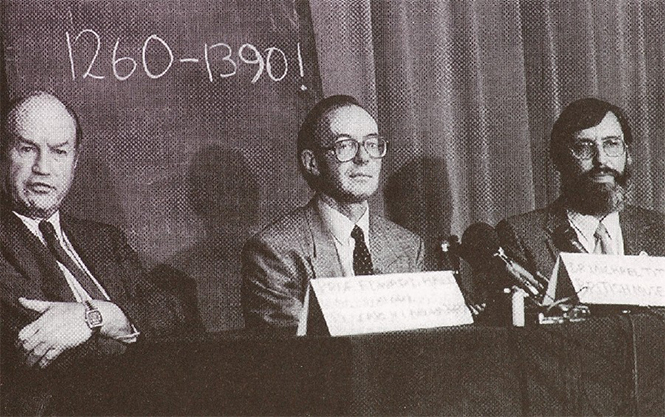
Opening Statements
Tite: Thanks for coming. We are here to announce the outcome of radiocarbon dating on samples from the Turin Shroud. Three independent laboratories carried out measurements using accelerator mass spectrometry. Their results agree with one another within statistical expectations. When the radiocarbon ages are calibrated to calendar years, the linen sample dates to the period AD 1260 to AD 1390 at the 95 percent confidence level. We will publish the full technical report in the scientific literature, including the individual laboratory results, the statistical tests of agreement, the calibration method, and the combined estimate. The data will be there, because the way to argue about this is with evidence, not rumor.
Hall: Let me be blunt about what that means. You do not get a medieval result like this from three labs by accident. These are not three random numbers forced into a story. The agreement is the story. The cloth is medieval.
Hedges: Be clear what the test dates. It dates carbon in the linen, effectively when the flax was harvested and made into cloth. It does not date an image, identify an artist, or determine motive. It answers one question: how old is the linen that was tested.
Q and A (Reconstructed Exchange)
Reporter So you are saying the Shroud definitely is not from the time of Jesus.
Tite The linen sample we tested is medieval. If someone wants to claim it is first century, they need to show how the measurement could be wrong by more than a thousand years, using data, not disbelief.
Reporter What about contamination: fires, smoke, handling, repairs, cleaning.
Hedges Contamination is exactly why there is pretreatment, to remove contaminants. To push a first-century cloth into the late Middle Ages requires a very large effect, not a small one. You would need to show a mechanism that adds or exchanges enough carbon to shift the age that far, while still producing consistent results across three independent labs.
Hall "It was in a fire" is not an argument by itself. Show the numbers. Show the chemistry. Otherwise it is just another way of saying you do not like the answer.
Reporter Were the laboratories blind. Did they know which sample was the Shroud.
Tite The process was designed to reduce simple bias. The labs worked within a set that included control samples. We will publish the technical details, but the central point is straightforward: three labs, consistent results, normal scientific standards.
Reporter There were leaks. Did you leak the result.
Tite No. What appeared in the press before today included speculation and guesswork. This is the official announcement, and the publication will follow.
Reporter So is it a forgery.
Tite Radiocarbon dating does not read intentions. It dates material. "Forgery" is a historical claim about motive. What we can say scientifically is that the linen is medieval.
Hall If you want context, the medieval period had a substantial market for relics and devotional objects. Combine that context with a medieval date and there is an ordinary historical explanation without requiring miracles.
Reporter Are you an atheist.
Hall I am not here to be converted by a piece of linen. I am here because we measured something and it has an answer.
Reporter Could you have dated a repaired section, not the original cloth.
Hedges That is a sampling question. If you want to claim the dated piece is not representative, you need evidence that the sampled material is an intrusive replacement or a major reweave. You do not get to wave at "repairs" and make a thousand years disappear. Bring evidence.
Reporter What is the single takeaway.
Tite The radiocarbon measurements place the tested linen sample in the period AD 1260 to AD 1390. The complete data will be published, and anyone can evaluate the work from the evidence.