Marguerite de Charny's Custody of the Shroud and Transfer to Savoy (1418-1464)
Geoffroy II de Charny died in 1398 at about 54 years old. His daughter Marguerite de Charny, born between 1385 and 1388, was around 12 at the time of his death. She married Jean de Bandremont in 1400 at around 14, was widowed at Agincourt on October 25, 1415 at around 29, and remarried Humbert de Villersexel in 1418 at around 32.
The surviving dossier at the Archives departementales de l’Aube, cote I 19, is especially useful for this period because it preserves not just the broad outline of the dispute with Lirey, but the actual cash payments, annual rents, and compensation promises attached to Marguerite’s continued custody of the Shroud.
This episode was not only about devotion or family prestige. For the canons of Lirey, the Shroud also meant offerings from pilgrims and income tied to public ostensions. That is why the records read so often like account books: each extension of Marguerite’s custody required either a cash payment, an annual rent, substitute endowment, or all three.

Family Wealth and Estate Background
Before 1398, the Charny family had built a large landed base. Pierre-Perthuis came through Geoffroy I’s first marriage to Jeanne de Toucy, Montfort came through his second marriage to Jeanne de Vergy, and in 1343 the crown assigned him estate revenues to support his foundation at Lirey. The family looked powerful, but part of that wealth was already tied to long-term obligations.
In 1353 Geoffroy I endowed the collegiate church at Lirey with permanent land income for six canons and supporting clergy. After his death at Poitiers in 1356, Jeanne de Vergy secured transfer of the royal income grant to their son Geoffroy II and obtained a royal house in Paris for him while he was still underage. By 1398, when Geoffroy II died, the family still held rank and property, but cash was less flexible than the titles suggested.
After 1398 the estate did not disappear, but control became harder to convert into ready money. Marguerite inherited the Charny position, and her 1400 marriage tied important rights to the Bauffremont network. After her first husband’s death in 1415, claims shifted again among relatives. In 1435 she exchanged major Burgundian properties (Beaumont-sur-Vingeanne, Montfort, Savoisy, Thury, Tonnerre) for Varambon and Bouligneux plus 4,000 gold coins. The contract itself says those Burgundian lands were difficult to manage in a war-damaged zone, and later records indicate the 4,000-coin payment was not fully made. In short, the family still held valuable assets, but reliable income and enforceable control were increasingly unstable.
Main Figures in the Dispute
- Marguerite de Charny: daughter of Geoffroy II de Charny and the central claimant to hereditary family rights over the Shroud.
- Humbert de Villersexel, count of La Roche: Marguerite’s second husband, who received the Lirey treasury in 1418 for safekeeping.
- Charles de Noyers: Marguerite’s brother, repeatedly acting as her surety and negotiator with the chapter.
- Philibert Thibault: Marguerite’s secretary and surety, named with her in the 1457 excommunication proceedings.
- Francois de La Palu, count of La Roche: heir of Humbert’s line and one of the principal opponents to Marguerite’s continued custody.
- Duke Louis of Savoy: the prince who acquired the Shroud from Marguerite’s side and later compensated the canons of Lirey with a perpetual annuity.
Wartime Transfer and Long Custody at Saint-Hippolyte (1418-1438)
Through Humbert’s mother, Guillemette de Vergy, Marguerite and Humbert were related. A receipt dated July 6, 1418 shows that, amid the insecurity of the Hundred Years’ War, the chapter of Lirey entrusted Humbert with the church treasury, including the Shroud among the “jewels and relics” placed in his care. The inventory described the object as a cloth kept in a chest bearing the Charny arms. That receipt mattered later because the canons treated it as proof of deposit for safekeeping, not proof of transfer of ownership. After a period at Montfort, the Shroud was kept at Saint-Hippolyte, where annual Easter public displays were held near the Doubs at Le Pre-du-Seigneur (also called Le Clos-Pascal). The Shroud remained there for nearly thirty years.
What the Lawsuit Was Really About
The legal core of the case was simple, even if the paperwork was not. Marguerite’s side argued that the Shroud belonged to the Charny family and had merely been left with the canons at Lirey. The chapter argued the opposite: the 1418 act showed an emergency wartime deposit into Humbert’s custody, so the cloth and the rest of the treasury still belonged to the church. Everything that followed, from rents and sureties to censures and Savoyard pensions, turned on that unresolved conflict between hereditary possession and ecclesiastical custody.
Litigation with Lirey (1438-1449)
Humbert died childless in 1438, when Marguerite was around 52. The canons of Lirey then demanded return of the Shroud and the other valuables entrusted in 1418. Their legal position was that this had been emergency safekeeping during wartime, not a transfer of ownership, so the chapter sought full return plus compensation for lost pilgrimage donations while the Shroud stayed away from Lirey.
The acts summarized in cote I 19 let us see the dispute in financial terms. In May 1443, when Marguerite was around 57, under the seals of the tabellionage of Gray and the officiality of Besancon, she restored the other jewels and relics but was allowed to keep the Shroud for three more years. In exchange she paid the chapter 30 livres up front and promised an annual rent of 12 francs for those three years to replace the alms lost at Lirey; she also undertook to return the Shroud earlier if Lirey passed to Francois de La Palu, count of La Roche, before the Nativity of Saint John the Baptist. In the same settlement she gave the chapter liturgical ornaments and confirmed the benefactions of her predecessors. Her brother Charles de Noyers stood surety for the agreement.
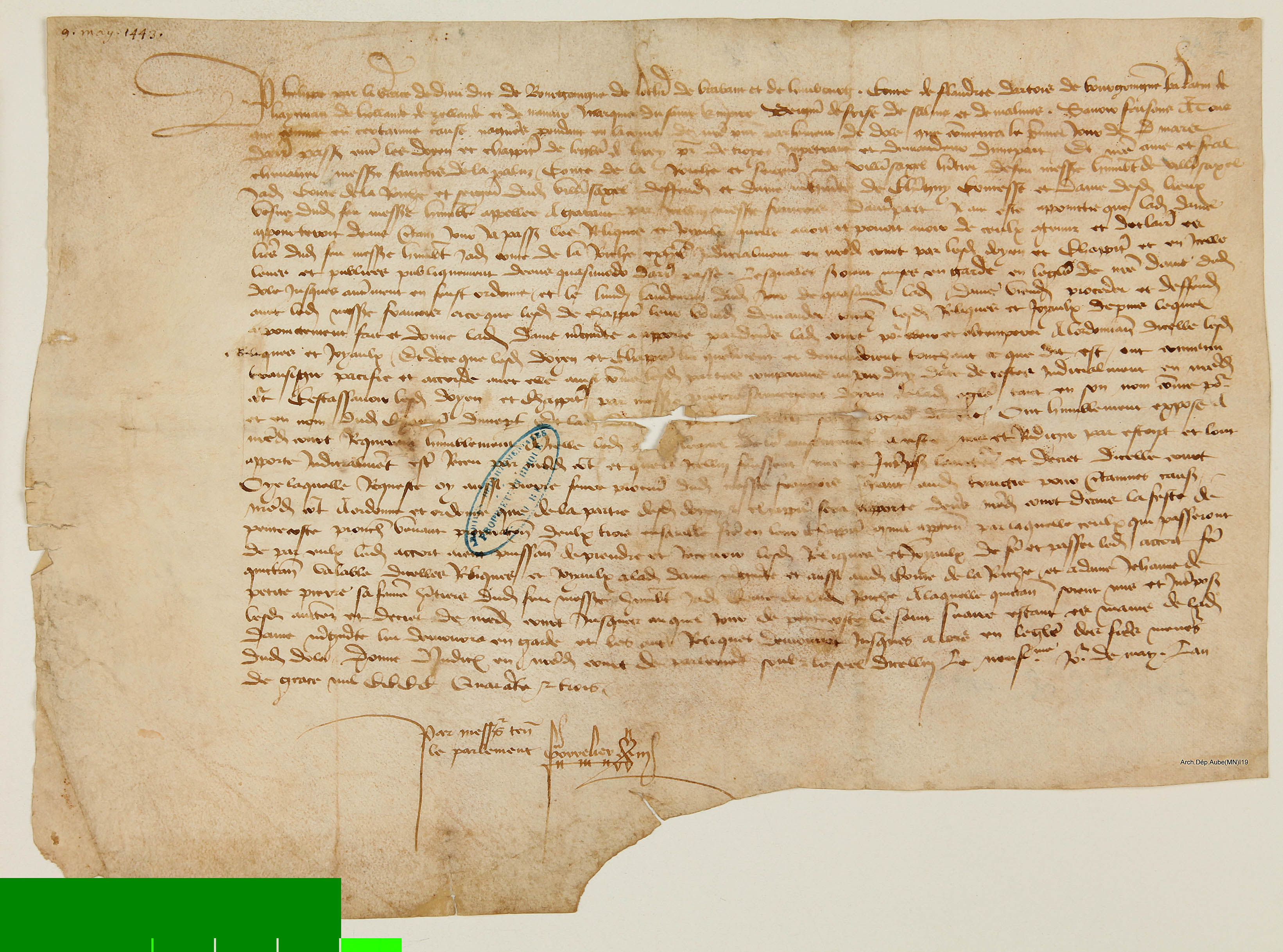
That same month, on May 9, 1443, the parliament of Dole ordered that Francois de La Palu’s opposition be heard before Pentecost, that the Shroud remain in Marguerite’s hands in the meantime, and that the other relics be deposited with the Franciscans at Dole. The arrangement did not settle the matter. On July 18, 1447, again under the officiality of Besancon, the chapter allowed Marguerite to keep the Shroud until the feast of Saints Simon and Jude in 1449, in return for 50 francs and an annual rent of 15 francs. When that term expired, the chapter still renewed the loan on November 6, 1449, even though the earlier obligations had not been fulfilled: under the seal of the provostship of Troyes, Charles de Noyers, acting for Marguerite, obtained another three years in exchange for an annual 50 livres and a promise to build a fortified place at Lirey to protect the canons and their relics. Across all of these agreements, Marguerite’s position did not change: the Shroud belonged to the Charny line and had only been deposited with the chapter.
One of the clearest surviving acts from this phase is the parliament’s order of May 9, 1443:
 Click to enlarge
Courts and Jurisdictions
The dossier moves through several courts because the parties, lands, and ecclesiastical authority were spread across more than one region. Gray and Besancon appear because Humbert and Marguerite were operating in Franche-Comte. Dole mattered because the parliament there handled part of the dispute over custody and inheritance. Troyes remained crucial because Lirey belonged to that diocese, while Reims appears in enforcement of the 1458 censures. Paris entered the story in 1464 because the final Savoy-Lirey accommodation was framed there at the level of princely settlement rather than local chapter litigation.
Traveling Exhibitions (1449-1453)
By the late 1440s, when Marguerite was around 63, she was carrying the Shroud across a broader courtly and political circuit. In 1449 she exhibited it at Chimay in Hainaut, placing it in the castle chapel. A Benedictine monk from the Abbey of Saint-Jacques in Liege attended and left a vivid description of what he saw.
The Chimay display triggered a formal church inquiry. Jean de Heinsberg, prince-bishop of Liege, sent two theologians to investigate. They required Marguerite to produce authorization linked to Clement VII and to state publicly that the object shown was a representation, not the burial Shroud itself. After their report, the prince-bishop banned further display in his diocese and expelled Marguerite.
She then moved through Burgundian territory, including Mons, which had been under Duke Philip the Good as Count of Hainaut since 1433. In 1452, at around 66, she stayed about a week at the Chateau de Germolles near Beaune and organized public showings on September 13 and 14. During Lent 1453, around age 67, she was in Geneva while Duke Louis of Savoy and Duchess Anne of Cyprus were in residence. Three public exhibitions are recorded there: Plainpalais on February 26, Rive before March 20, and the private chapel of Jean de Rolle on March 25.
These traveling exhibitions intensified her conflict with Lirey and with regional church authorities, while the chapter’s compensation claims kept accumulating in the background.
Savoy Settlement and Financial Terms (1453-1455)
By the time Marguerite left Geneva, custody had shifted to Duke Louis of Savoy. Acts dated March 22 and March 29, 1453, when she was around 67, granted her lifetime use of the castle, town, and castellany (administrative district) of Miribel. In 1455, around age 69, Miribel was replaced by the castle and castellany of Flumet as frontier policy changed.
The documents do not name the Shroud directly, consistent with church rules against open relic sales, and present the arrangement as grants for services. Even so, the financial structure is clear. Documentary reconstruction indicates that Duke Louis took over the still-unpaid 4,000-gold-coin obligation from Marguerite’s earlier settlement with Francois de La Palud, then added annual pensions of 100 gold florins from Montluel revenues and 1,000 gold florins from Chateauneuf-en-Valromey, plus a grant of 10,000 gold coins. These are medieval coin values and cannot be converted cleanly into modern euros, but they represent substantial purchasing power. Parts of this package were later revised during the political crisis of 1454-1455.
Sanctions, Settlement, and Closure (1457-1464)
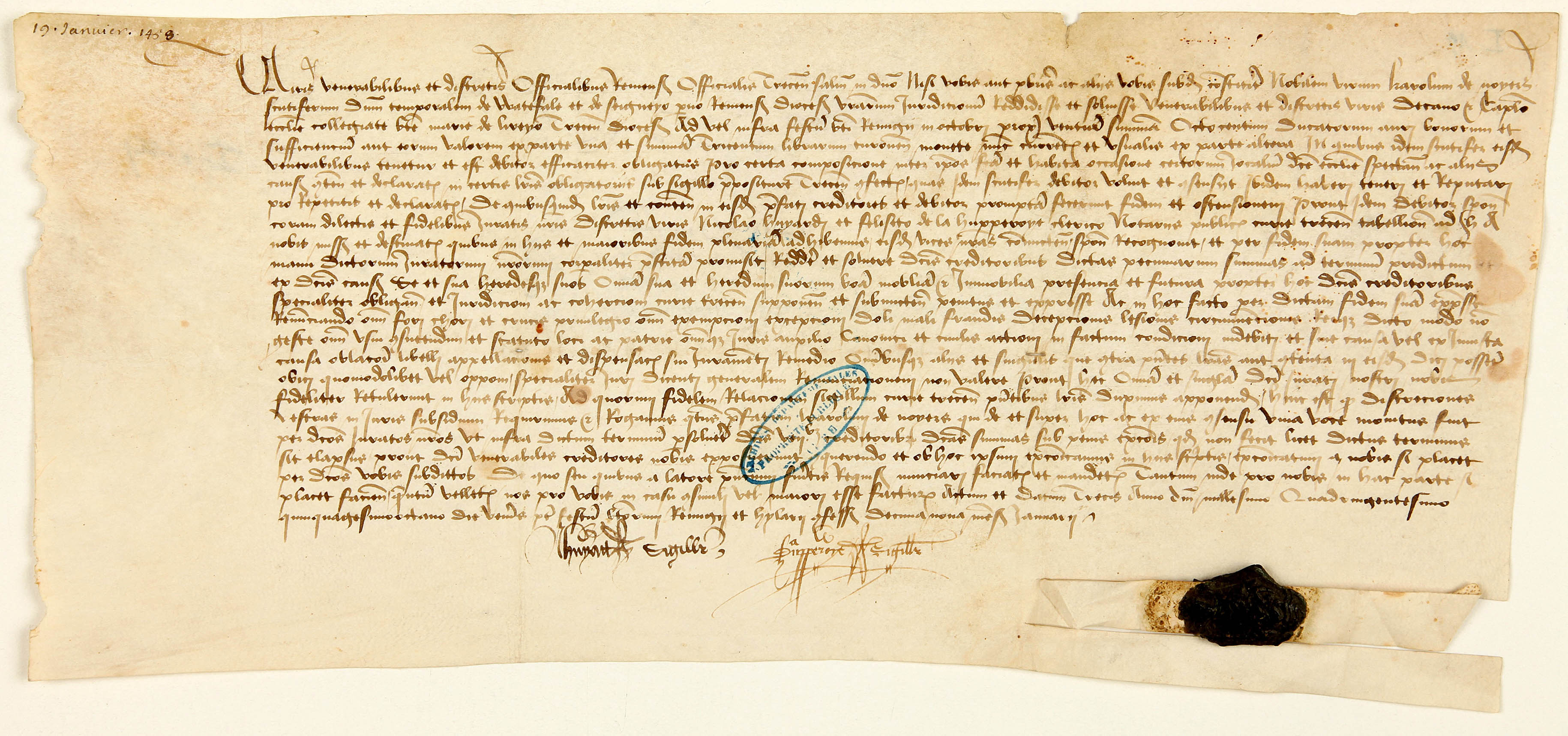
The canons of Lirey challenged the Savoy transfer before the archiepiscopal court of Besancon. Marguerite was excommunicated on May 30, 1457, when she was around 71, together with her surety Philibert Thibault, for refusing to return the Shroud and to satisfy the obligations attached to the chapter’s earlier concessions. On January 19, 1458, Charles de Noyers tried to settle the matter on her behalf: he promised 800 gold ducats that Marguerite had previously undertaken to pay for the continued loan of the Shroud, another 300 livres to compensate the chapter for lost alms and litigation costs, and to seek papal and episcopal permission for permanent alienation of the cloth. In return, the chapter agreed to have the excommunication lifted, stated that the money would be put to useful restoration of the church, and in practice acknowledged that recovering the Shroud now seemed unlikely.
The same day also produced an enforcement mechanism. The officiality of Troyes directed the officials of Reims to notify Charles de Noyers that he too would incur excommunication if the 800 ducats and 300 livres were not delivered by the feast of Saint Remi. The record therefore shows that the 1458 composition was not a clean resolution, but a pressured attempt to regularize a situation that had already escaped the chapter’s control.
The 1458 settlement attempt also survives as a sealed act:
 Click to enlarge
The historical record is not uniform on Marguerite’s death date: one reconstruction gives October 7, 1459, while another gives October 7, 1460. In either case, she died in her early seventies. No surviving act in the core document set securely identifies the place of her death. On February 6, 1464, Duke Louis of Savoy granted the chapter a perpetual rent of 50 gold francs on the revenues of Chateau-Gaillard near Geneva and endowed liturgical offices at Lirey in compensation for the harm caused by Marguerite’s cession of the Shroud. This February 6 act is the first known Savoy document to mention the Shroud explicitly. On May 23, 1464, Louis wrote again to the canons, telling them to stop publicizing the excommunication of Marguerite and Philibert Thibault and reminding them that he had already compensated them with a perpetual annuity. A later procuration of May 14, 1473 shows that the annuity was still in arrears: the chapter was still appointing agents to pursue Louis’s widow for execution of the 1464 agreement.
Later Memory of the Dispute (1725-1726)
The same archival dossier also preserves later correspondence showing that the Marguerite story remained active in local memory long after the transfer to Savoy. In September 1725, Canon Sergent of Villersexel wrote to the chapter of Lirey asking whether it was really true that the Shroud had been kept at Lirey, then carried to Saint-Hippolyte by Humbert de La Roche in 1418, then taken to Chambery by Marguerite de Charny, after which the chapter had pursued lawsuits to get it back. The letter is valuable not because it adds new 15th-century evidence, but because it shows which points of the story still circulated by tradition in the Villersexel region three centuries later.
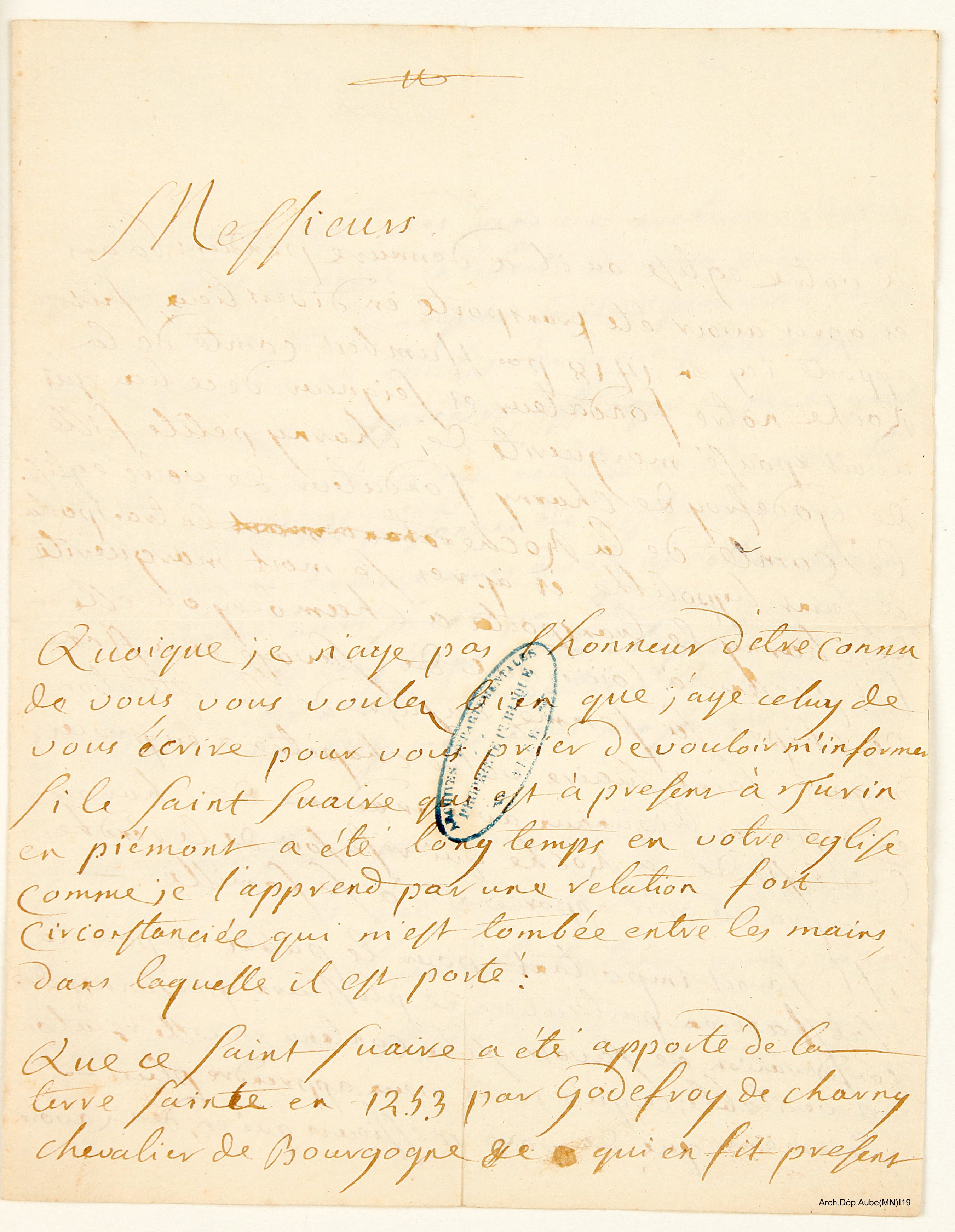
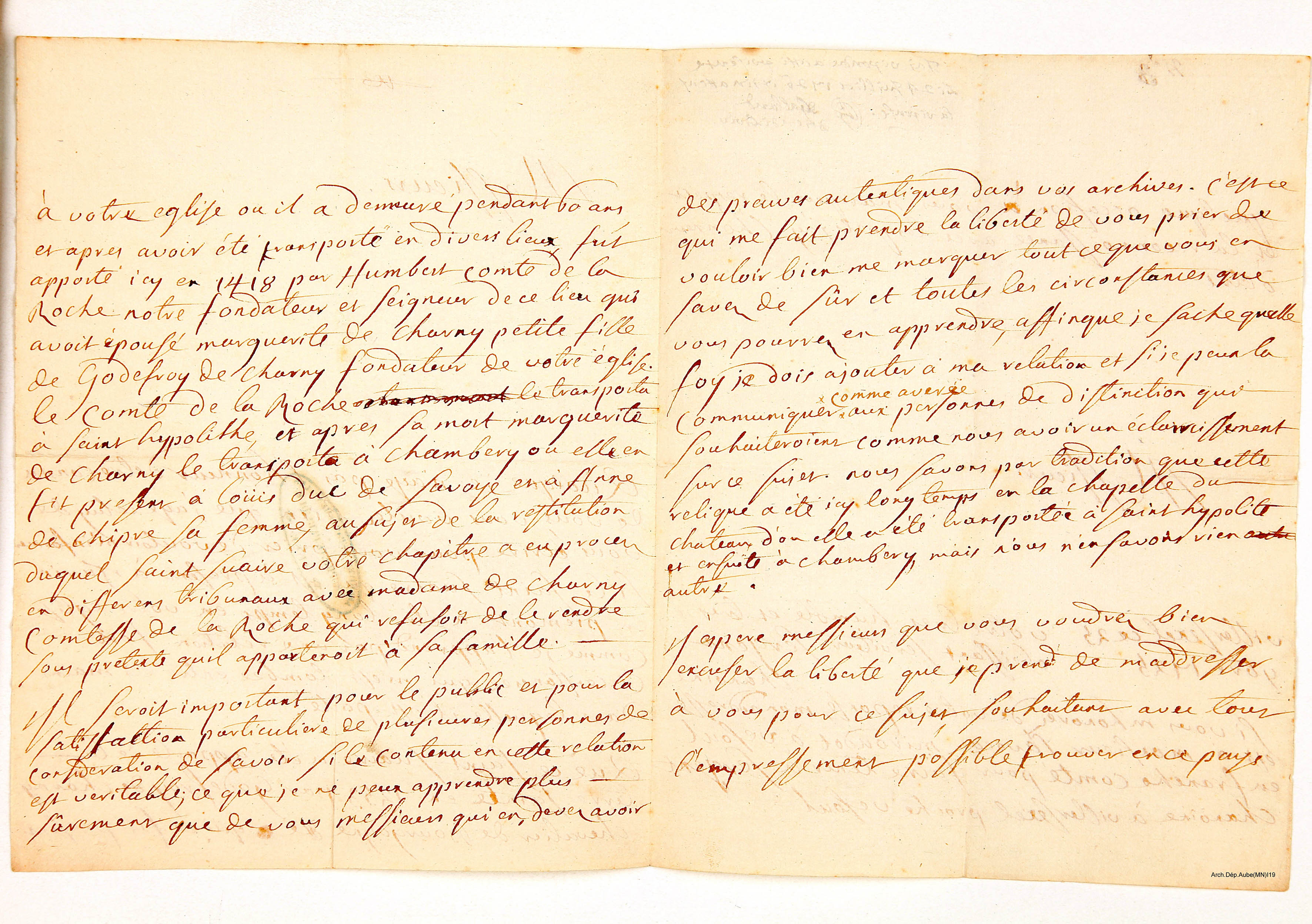
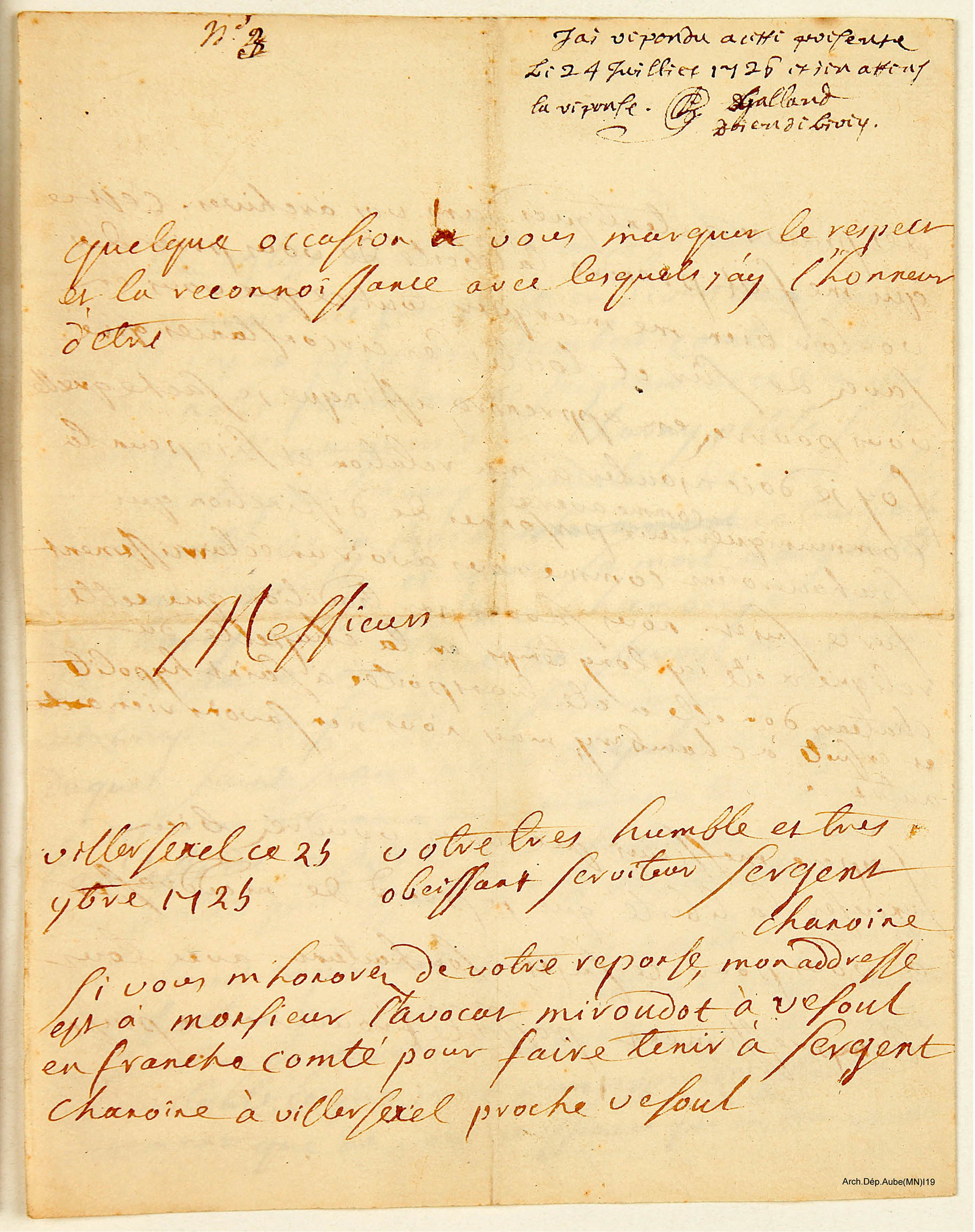
Three-page letter from Canon Sergent of Villersexel to the chapter of Lirey, 25 September 1725. He asks the canons to confirm the traditional account linking Lirey, Saint-Hippolyte, Marguerite de Charny, and the Savoy transfer. Click any page to enlarge.
A follow-up letter of June 25, 1726, together with its address and endorsement pages, shows that Sergent had still received no answer and wrote again. It adds an important admission: Villersexel knew the Shroud story mostly by tradition and was looking to the archives at Lirey for documentary confirmation. That makes the letter a useful witness to 18th-century memory, but not an independent proof of the 15th-century events themselves.
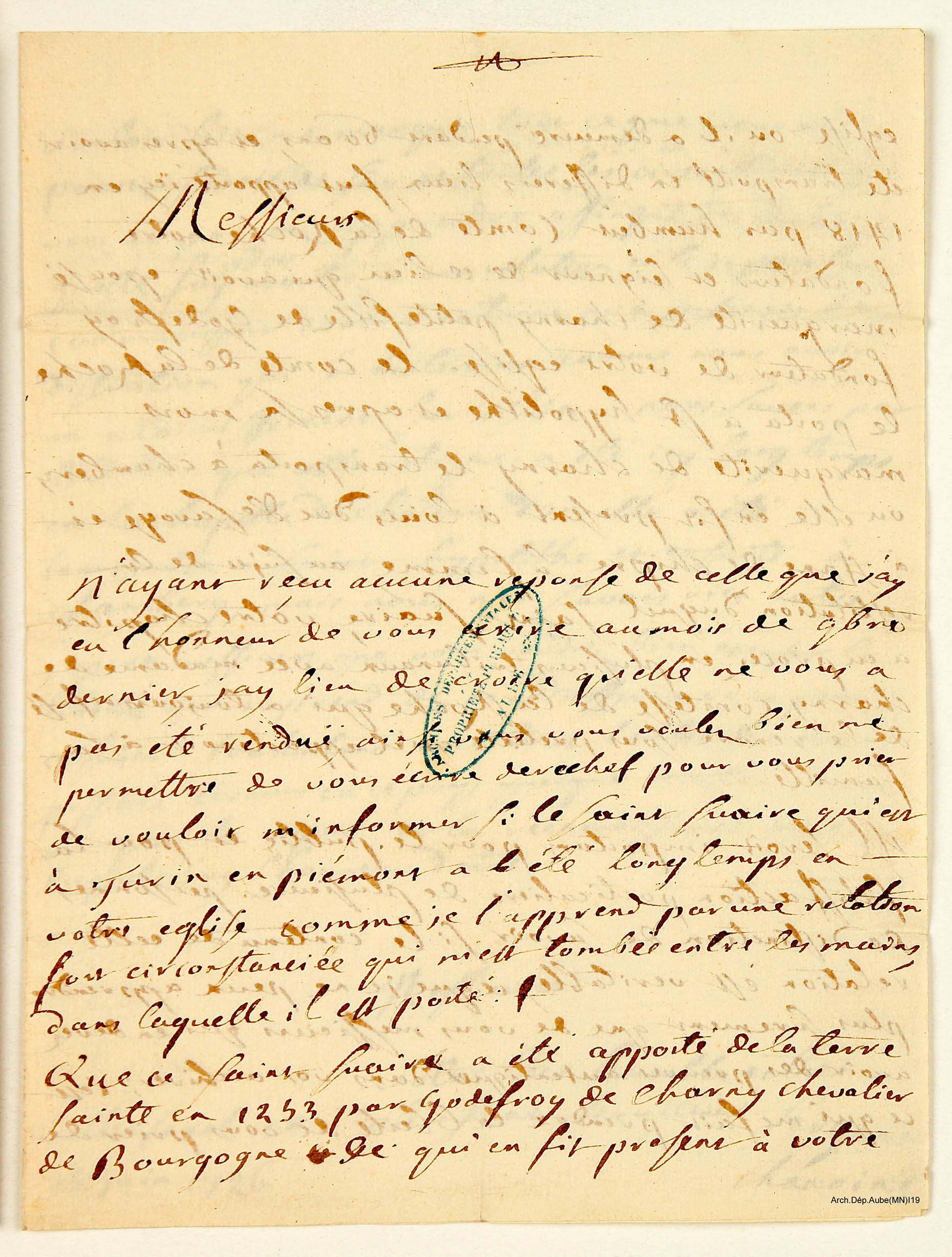
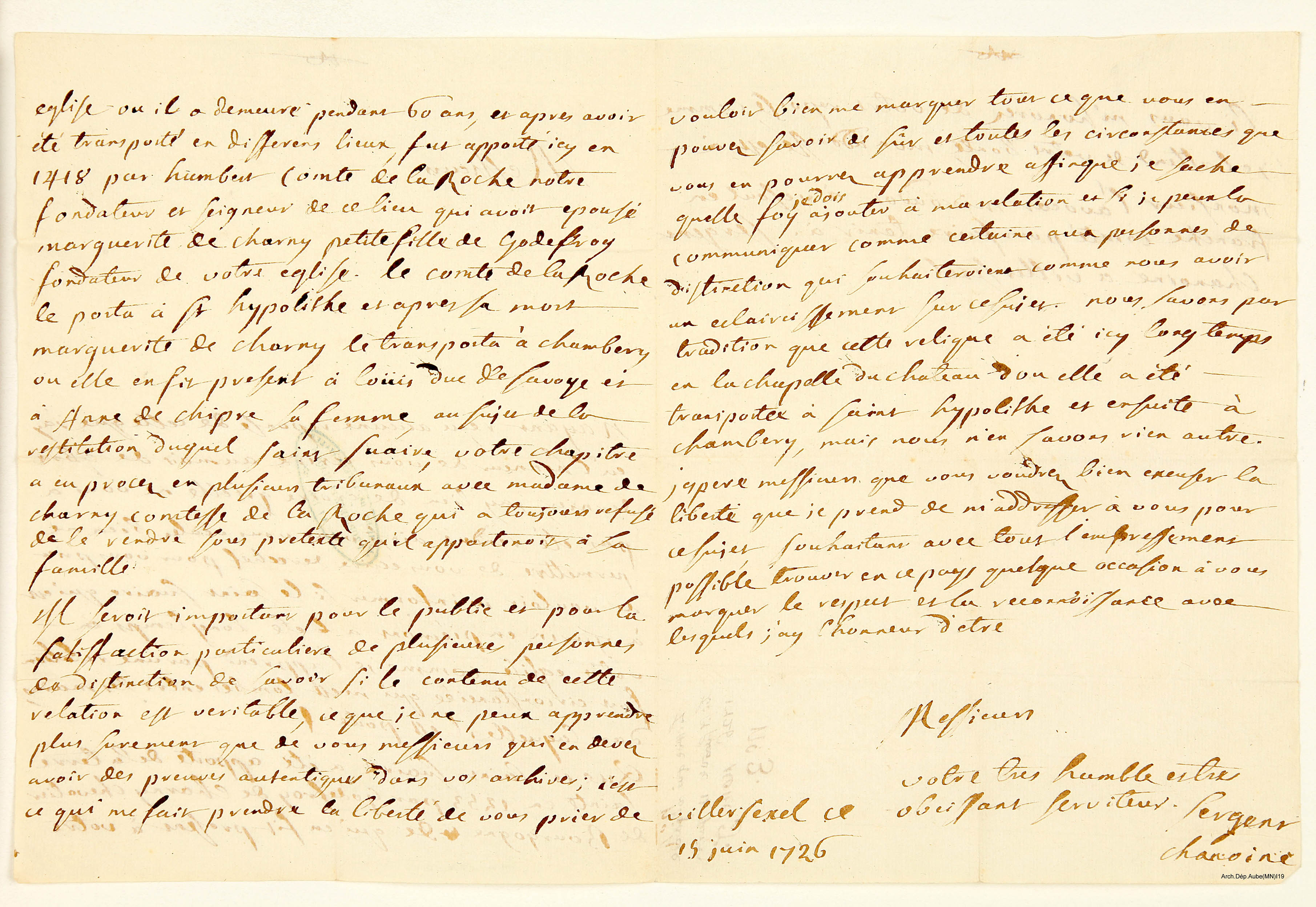
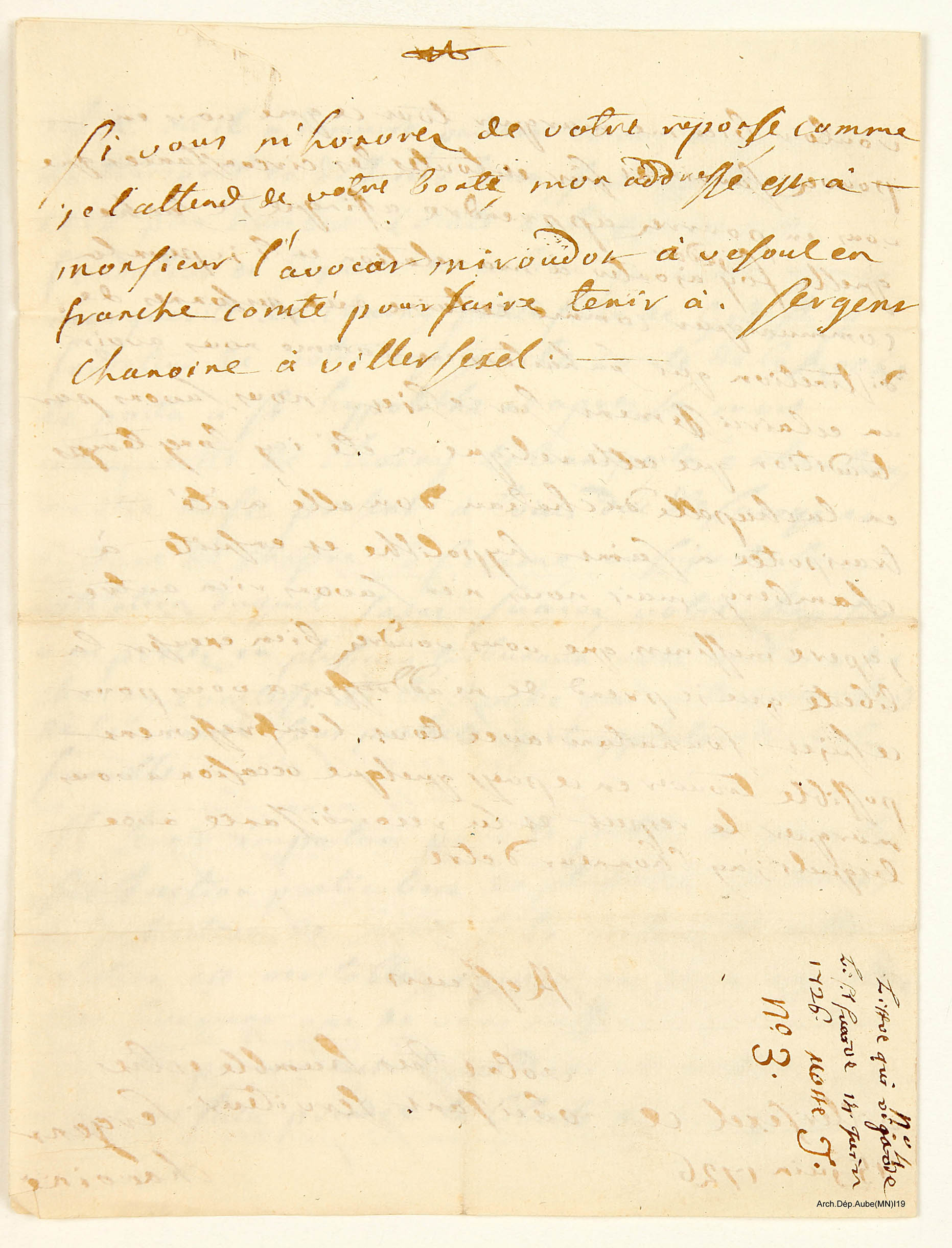
Follow-up letter and address/endorsement pages from Canon Sergent of Villersexel, 25 June 1726. The text repeats the request for confirmation and shows that Villersexel itself relied on local tradition rather than preserved records. Click any page to enlarge.
Chronology of the Main Settlements
July 6, 1418. Act: Receipt of Humbert de Villersexel for the Lirey treasury. Amount promised to Lirey: none at this stage. Result: basis for the later dispute over whether the Shroud had only been deposited or was privately owned.
May 1443. Act: Restitution agreement under the seals of Gray and Besancon. Amount promised to Lirey: 30 livres up front and 12 francs annually for three years. Result: Marguerite keeps the Shroud temporarily and Charles de Noyers stands surety.
May 9, 1443. Act: Parliament of Dole ruling. Amount promised to Lirey: no new sum fixed. Result: the Shroud remains with Marguerite pending judgment, while the other relics are deposited with the Franciscans at Dole.
July 18, 1447. Act: New extension granted by the chapter. Amount promised to Lirey: 50 francs up front and 15 francs annually. Result: Marguerite may keep the Shroud until the feast of Saints Simon and Jude in 1449.
November 6, 1449. Act: Renewal under the provostship of Troyes. Amount promised to Lirey: 50 livres annually. Result: another three years are granted, along with a promise to fortify Lirey.
May 30, 1457. Act: Excommunication sentence. Amount promised to Lirey: no payment made. Result: Marguerite and Philibert Thibault are censured for noncompliance.
January 19, 1458. Act: Settlement attempt by Charles de Noyers. Amount promised to Lirey: 800 gold ducats and 300 livres. Result: the chapter agrees to lift censures if payment is made and the necessary permissions are secured.
February 6, 1464. Act: Savoy compensation act. Amount promised to Lirey: a perpetual rent of 50 gold francs. Result: Duke Louis compensates Lirey from Chateau-Gaillard revenues.
May 14, 1473. Act: Lirey procuration to recover arrears. Amount promised to Lirey: arrears still unpaid. Result: the chapter is still pursuing execution of the 1464 agreement from Savoy’s side.
Historical Significance
Taken together, these records show more than a devotional itinerary. The dossier in cote I 19 turns the dispute into a ledger: 30 livres and 12 francs a year in 1443, 50 francs and 15 francs a year in 1447, 50 livres a year in 1449, an attempted 800-ducat plus 300-livre composition in 1458, and finally a perpetual Savoyard rent of 50 gold francs in 1464. That sequence ties inheritance pressure, pilgrimage income, and negotiated compensation directly to the transfer of the Shroud from the Charny line to the House of Savoy.
Sources & References
- Archives departementales de l'Aube, cote I 19, 'Saint-Suaire' dossier summary (acts from 1390 to the 18th century). View source →
- Francois-Xavier de Villemagne, 'Le Saint Suaire de Lirey au duc de Savoie (1418-1464)', Revue de l'Academie salesienne 26. View source →
- BSTS Newsletter No. 38, Part 6, 'A Chronology of the Shroud 1452-1509.' View source →
- Shroud News No. 88, Part 3, Ian Wilson, 'Shroud Acquired by Duke Louis of Savoy in 1453: The Documentary Evidence.' View source →
- Andrea Nicolotti, 'The Veil of the Goddess: The Alleged Travels of the Shroud to the East,' pages 97-98 (Oxford University Press, 2020). View source →